SOLAR SERVICES
Six services. One contractor accountable for all of them.
Commercial and industrial solar, residential rooftop, agricultural pumping, battery storage, operations and maintenance, and energy auditing. Engineered in-house, installed by our own crews.
SERVICE GRID
What we build, and exactly what is included
Every scope below includes design, supply, installation, testing, commissioning documentation and warranty registration.
01 Commercial
Commercial & Industrial Solar
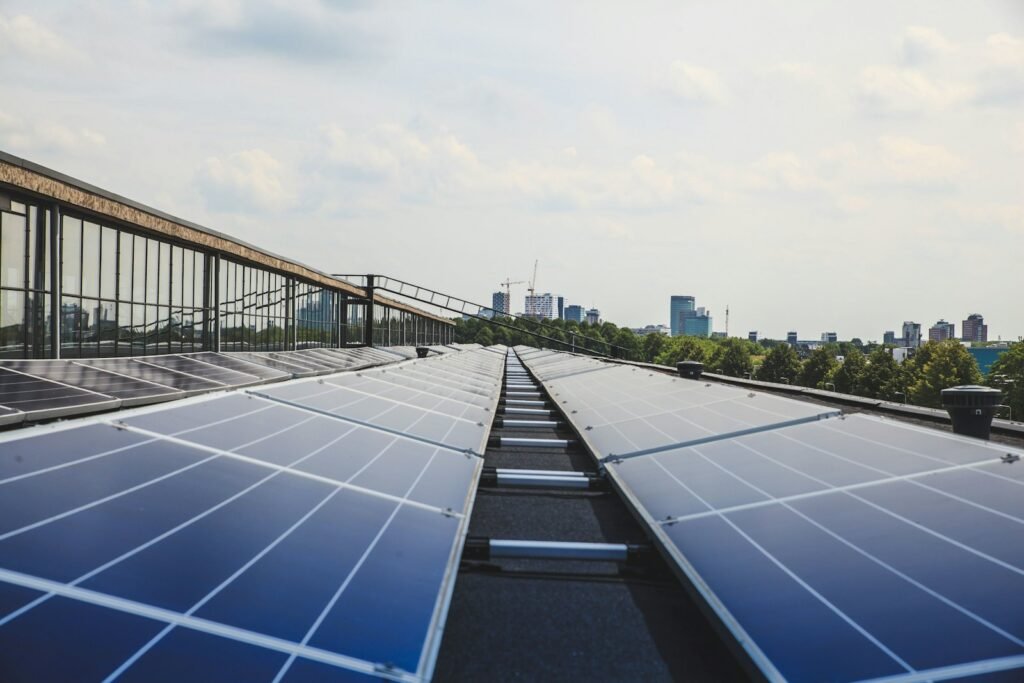
Rooftop and ground-mount PV from 50 kWp to multi-megawatt, sized against your measured daytime load rather than your roof area.
- Structural load and wind-uplift assessment
- String or central inverter topology
- Generator synchronisation and export control
- Net-metering application handled end to end
02 Residential
Residential Rooftop Solar
Grid-tied or hybrid systems from 3 kWp to 25 kWp, surveyed one week and commissioned the next, in a single working day.
- Waterproofed mounting, warranty-backed
- Optional LFP battery for outage backup
- Phone app with live generation
- Two free cleaning visits in year one
03 Agriculture
Solar for Agriculture
Tube wells, irrigation pumps and cold stores. VFD-driven, dust-hardened, sized to the seasonal duty cycle.
- 5 HP to 75 HP pump sets
- Hot-dip galvanised ground structures
04 Storage
Battery Energy Storage
LFP storage for peak shaving, load shifting or full backup autonomy, with hybrid inverters transferring in under 20 ms.
- 5 kWh to 500 kWh scalable racks
- Active BMS with thermal management
05 O&M
O&M and Monitoring
Scheduled cleaning, IV-curve and string testing, drone thermography and 24/7 remote alerting under one annual contract.
- 48-hour on-site response SLA
- Quarterly performance-ratio reporting
06 Audits
Energy Audits & Feasibility Studies
Before we sell you a single panel, we will tell you whether solar is even the right first move. A Recon Energy audit profiles your consumption at 15-minute resolution, checks power factor and harmonics, models three system scenarios and returns a written recommendation, including the option to do nothing. Roughly one in nine audits ends with us advising a client to fix their power factor first and revisit solar next year.
- 15-minute resolution load profiling
- Power factor and harmonic study
- Three modelled scenarios, in writing
HOW IT WORKS
Six steps, fully mapped
You will always know which step you are on and who owns it. Typical commercial timeline: 4 to 7 weeks. Residential: 5 to 10 days.
01
Discovery call
Fifteen minutes. Your consumption, your roof, your goal: backup, bill reduction or carbon.
02
Site survey
Physical measurement, shadow analysis, structural check and electrical infrastructure review.
03
Engineered proposal
Array layout, single-line diagram, P50/P90 yield, bill of materials and payback, in writing.
04
Approvals
Net-metering application, utility liaison and any structural sign-off, filed and tracked by us.
05
Installation
Structure, modules, DC and AC works, protection devices and earthing, by our own certified crews.
06
Commission & handover
String testing, thermography, app onboarding and a complete as-built documentation pack.
07
Ongoing O&M
Cleaning schedule, annual testing and remote monitoring for as long as the asset runs.
08
Performance review
Quarterly report comparing actual generation against the model you were sold.
SCOPE CLARITY
What is always included, and what genuinely costs extra
Included
Site survey, engineering, mounting structure, DC/AC cabling, protection devices, earthing, commissioning, documentation, app onboarding and warranty registration.
Quoted separately
Roof strengthening, transformer or switchgear upgrades, civil works for ground-mount, and battery capacity beyond the base design.
Never charged
The initial survey, the yield model, revisions to the design, and the first year of remote monitoring.
FAQ
The questions we get asked every week
How long does a solar installation actually take?
A residential system is usually installed and commissioned in one working day, roughly one to two weeks after survey. Commercial projects run 4 to 7 weeks from signed proposal to commissioning, with net-metering approval typically the longest single item.
What size system do I need?
It depends on your daytime consumption, not your total bill. A facility that runs machinery 9am to 6pm can offset far more of its load than one that runs at night. We pull twelve months of consumption data and match the array to your actual load curve.
Will solar work during outages?
Only if the system is designed for it. A standard grid-tied inverter shuts down during an outage for safety reasons. If backup matters, you need a hybrid inverter with battery storage, which keeps selected circuits live and transfers over in under 20 milliseconds.
What maintenance does a solar array need?
Less than people expect, but not zero. Dust and bird soiling can cost 8 to 20 percent of output in dry seasons, so cleaning frequency matters more than most owners realise. Beyond that: annual string and insulation testing, thermography, and connection torque checks.
How long do panels last, and what is the warranty?
Tier-1 modules carry a 25 to 30 year performance warranty, typically guaranteeing above 85 percent of rated output at year 25, plus a 12 to 15 year product warranty. Inverters run 5 to 12 years and LFP batteries are rated to around 6,000 cycles.
Do you handle net-metering paperwork?
Yes. Application forms, single-line diagrams, load calculations, inspection coordination and utility follow-up are all part of our scope at no extra charge. We will also tell you upfront if your connection capacity limits the export size you can be approved for.
Can my roof take the weight?
Usually, but it gets checked rather than assumed. A modern array adds roughly 12 to 18 kg per square metre. Wind uplift is the bigger engineering question, especially on lightweight industrial sheeting. Our survey includes a structural assessment.
NEXT STEP
Tell us your load. We will tell you the truth.
Send one recent bill and a photo of your roof. Within three working days you will have a fully engineered proposal, or an honest explanation of why solar is not your best next move.